Stamford Search
Specialist Retained Executive Search for Data & Analytics Leadership
Helping UK Series A & B SaaS companies reduce avoidable hiring risk in critical Data & Analytics leadership appointments.
Why Data Hiring Mistakes Happen
Difficult Data leadership searches are not always caused by a shortage of capable candidates. They can become difficult because the role evolves while the search is underway, different stakeholders begin evaluating candidates against different expectations, or success has not been clearly agreed before the market is approached.A company may begin by looking for someone to improve reporting, then gradually add responsibility for Data Engineering, commercial analytics, AI and organisational change. The job title may remain the same while the role itself changes significantly.By the time this becomes obvious, several credible candidates may already have been assessed against different versions of the role. Candidate availability is only part of the challenge; the search also depends on whether the organisation is aligned on the appointment it is taking to market.
The Operational Consequence
When a critical leadership search drifts, the impact is seldom limited to a delayed appointment.
More commonly, founders experience:• roadmap execution slowing
• technical debt becoming harder to address
• ownership remaining unclear
• stakeholder confidence weakening
• continued founder involvement in decisions that were expected to be delegated
• capable candidates withdrawing as the process becomes prolonged or uncertainThese issues usually emerge gradually. By the time they become fully visible, valuable management attention and execution momentum may already have been lost.
How Critical Searches Are Calibrated Before Entering the Market
Search Calibration
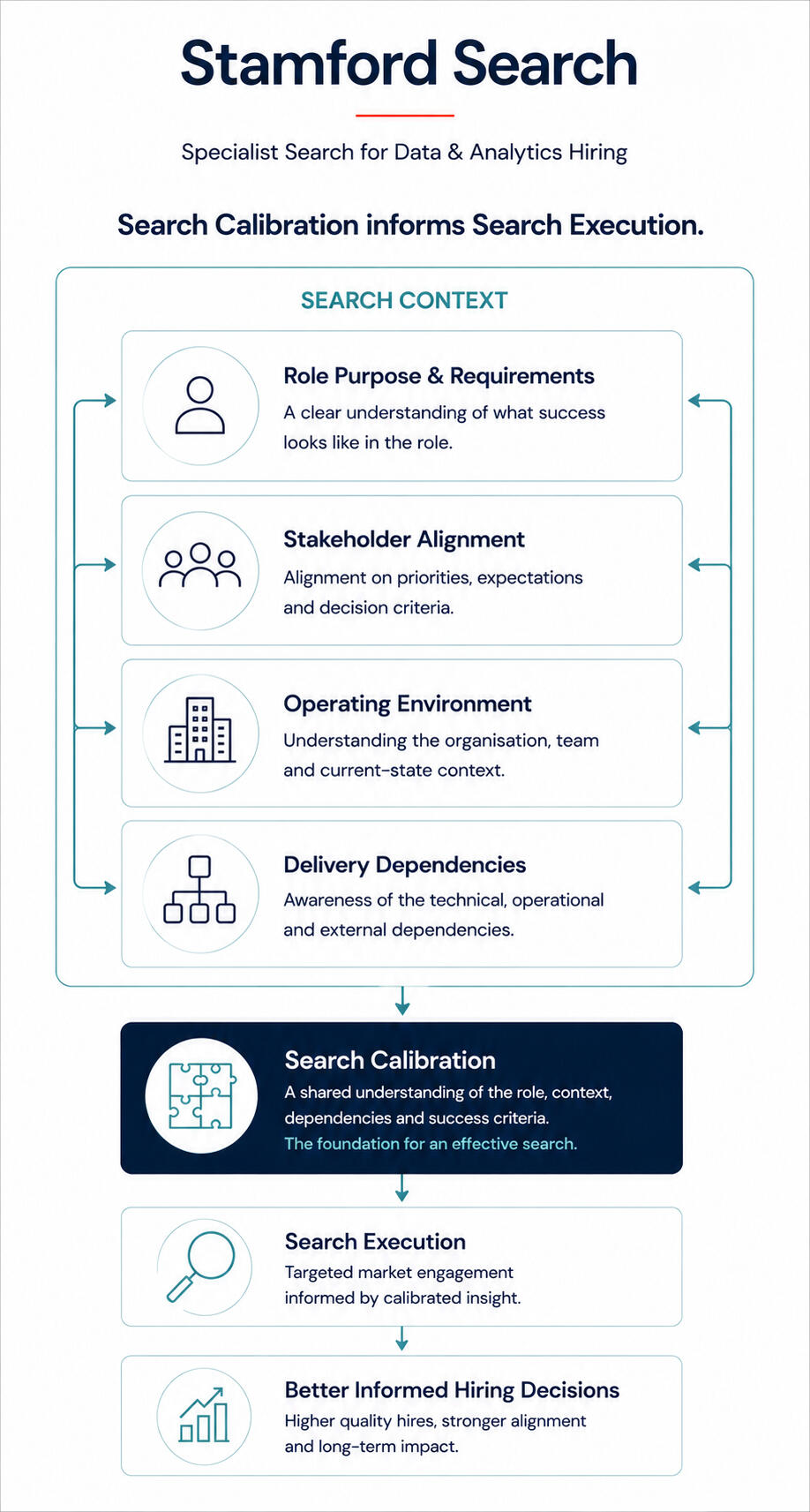
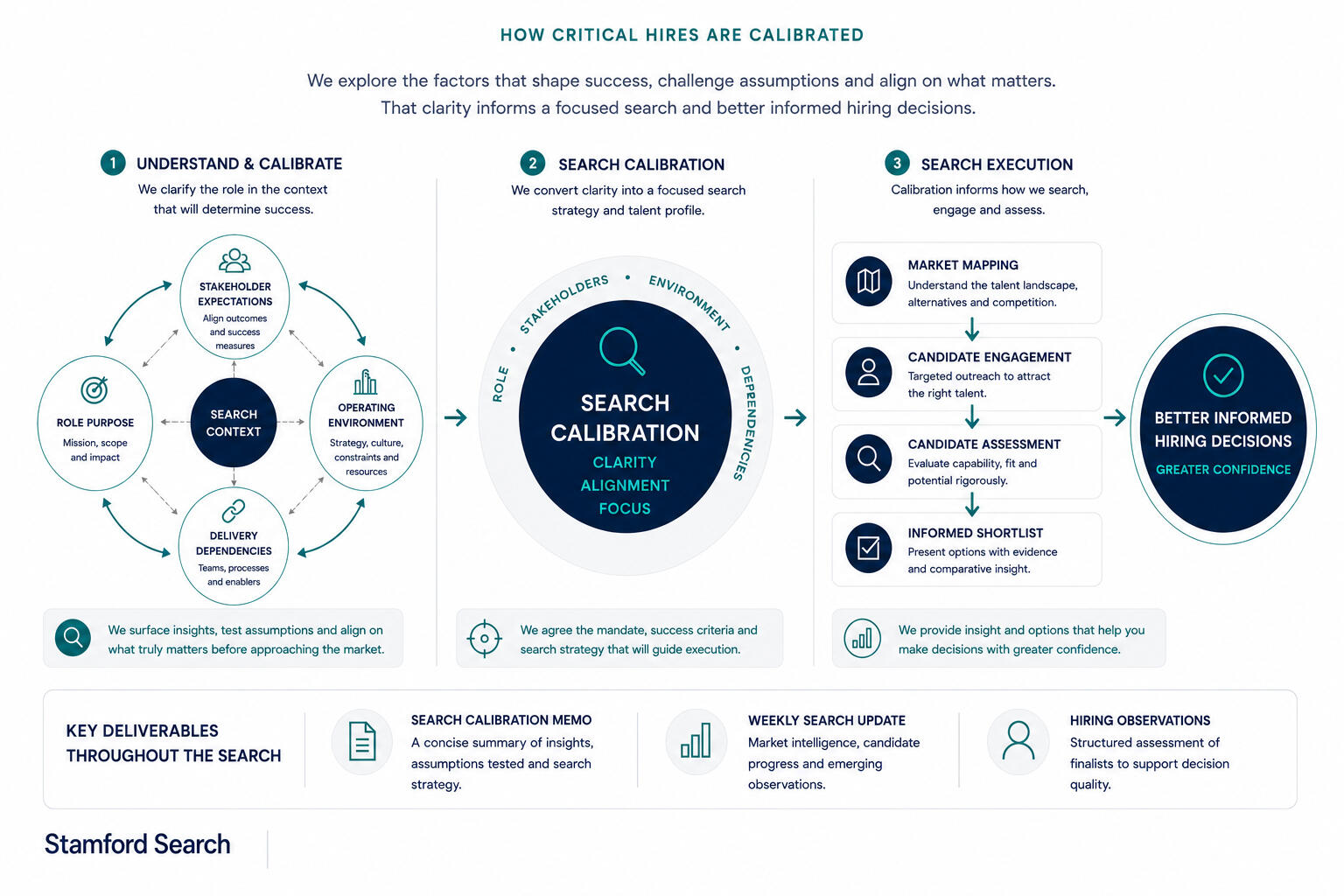
Every Stamford retained search begins with Search Calibration. By this stage, the objective isn't to redefine the organisation; its purpose is to establish enough clarity for a focused and stable search before candidates are approached.Before entering the market, Stamford tests four practical areas:Role Purpose - what the appointment must actually achieve.Stakeholder Expectations - whether those involved share a sufficiently similar view of what success looks like.Operating Environment - the authority, resources and conditions the successful candidate will inherit.Delivery Dependencies - which business outcomes depend most on the appointment.Consequently, before the search begins, the client knows what the hire must achieve, where key stakeholders differ, and what evidence candidates will be judged against.Search Calibration forms part of every retained search. It is not a separate consulting engagement and does not remove uncertainty. Its purpose is to reduce avoidable ambiguity before that ambiguity reaches the candidate market.
Market Execution
Once the appointment is sufficiently clear, Stamford takes it into the market through targeted mapping and direct candidate engagement, including relevant leaders who may not be actively considering a move.Throughout the assignment, the client gains visibility of:• how the relevant candidate market is responding;
• where credible candidates align with or challenge the agreed requirements;
• whether scope, authority, compensation or other assumptions are affecting interest;
• how candidates compare against the same agreed outcomes and operating conditions.Candidate assessment remains anchored to the appointment established during Search Calibration rather than allowing the criteria to shift with each interview. Where repeated market evidence challenges an assumption, Stamford explains what we are seeing, why it matters and what I recommend. Stamford remains directly involved through candidate engagement, assessment, shortlist, offer and appointment.
Why This Matters
A critical leadership hire is more than a recruitment decision. It commits capital, management attention and execution capacity, while some of the consequences may only become visible long after the recruitment process has finished.Successful outcomes depend as much on the conditions surrounding a hiring decision as the decision itself.When the role, expectations and operating environment are clearly understood before the market is approached, the search is more likely to remain focused and stakeholders are more likely to evaluate candidates consistently. Reducing avoidable hiring risk therefore begins long before the final interview; it begins by making sure the organisation is searching for the right appointment.
Professional Accountability
Stamford is led by a Chartered Engineer registered with the Engineering Council. My background in engineering shaped the way I approach important decisions through structured thinking, evidence and professional accountability. Those same principles now underpin every retained search.
How Stamford Works
1. Establish What The Hire Must Deliver
Establish the business outcomes the appointment needs to influence before entering the market.
2. Enter The Market With A Clearer Brief
Align the role, stakeholder expectations and the conditions the successful candidate will inherit.
3. Reach And Compare The Relevant Leaders
Directly engage the relevant market and assess candidates against the same agreed outcomes and operating conditions.
4. Keep The Decision Moving
Use candidate and market evidence to maintain focus through assessment, offer and appointment.
When Stamford Is Typically Engaged
Stamford is usually engaged when:• a Data or Analytics leadership hire has become business-critical
• a previous leadership appointment has fallen short of expectations
• roadmap execution depends on the success of the role
• the appointment has evolved beyond its original brief
• different stakeholders are hiring for different versions of the role
• several credible candidates have proved difficult to compare consistently
• the business cannot afford another six months without accountable leadership
• founders want greater clarity before committing to an important appointment
Outcome
The purpose of Stamford’s approach is to reduce the avoidable issues that make critical leadership searches slower, less consistent and harder to execute.
Every retained search is designed to establish a stronger foundation before the market is approached and to maintain that focus throughout the assignment.In practical terms, that should mean:• fewer material changes to the search brief after candidate engagement begins
• greater agreement on what success looks like
• more consistent evaluation across stakeholders
• clearer comparison between credible candidates
• less avoidable rework during the search
• stronger alignment between the appointment the company intended to make and the leader it ultimately appointsNo retained search can eliminate uncertainty. Search Calibration is intended to reduce the ambiguity that can reasonably be addressed before and during the search. That is how Stamford seeks to reduce avoidable hiring risk.
Planning A Critical Data Or Analytics Leadership Appointment?
The best time to clarify the appointment is before the candidate market is approached. A short initial conversation can help establish whether the role is sufficiently clear, where the main uncertainties sit, and whether Stamford is relevant.The conversation is exploratory and does not commit you to an engagement.Arrange A Search Readiness Conversation
Stamford Search Ltd
Registered in England & Wales No. 11299541
Registered Office: 20–22 Wenlock Road, London N1 7GU
[email protected]
© 2026 Stamford Search Ltd. All rights reserved.